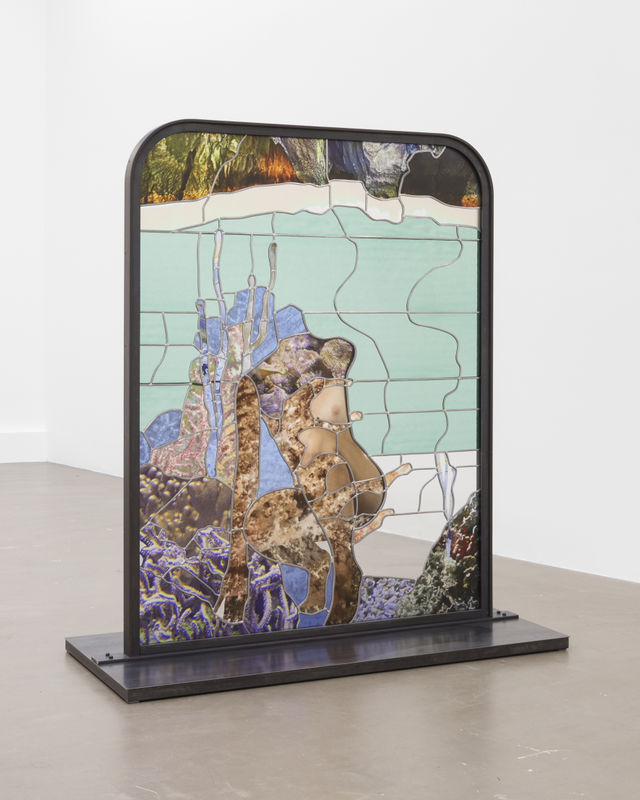
Clara Rivault is a French artist born in 1991. She graduated from the École Supérieure des Beaux-Arts Montpellier Contemporain and holds a Master’s degree from La Cambre in Brussels. It was at the International Glass Art Center of Meisenthal that she discovered the medium of glass.
Clara Rivault explores a range of complex traditional techniques associated with the fire arts, such as bronze, glass, and porcelain. Specializing in stained glass, she engages in a time-intensive creative process initiated through photographic sampling, which she then fragments, recomposes, and crystallizes to construct narratives where mythology and the real world intertwine.
Her observation of organic materials and living tissues informs a vocabulary of forms and textures that she breathes into glass, giving them a sculptural dimension. The notion of the body acts as a sustaining thread throughout Clara Rivault’s polymorphous practice.
A recipient of the HEDERA project, she created in 2023 a monumental work for the façade of the Institut français headquarters in Paris. She was also selected to design the stained glass windows for the Church of Saint-Paterne in Saint-Pair-sur-Mer; her work Lunam et Solem will be inaugurated in 2026, alongside a stained glass piece created for the façade of the Les Franciscaines museum in Deauville. In parallel, Clara Rivault designed a stained glass window for the tomb of Lisa Gherardini—model for Leonardo da Vinci’s Mona Lisa—at the Sant’Orsola Museum in Florence.
More recently, she has exhibited at the Centre d’art Les Églises in Chelles (2024) and at MOCO in Montpellier (2025). In 2026, her work is presented at the MUCEM as part of the group exhibition Bonnes Mères, curated by Caroline Chenu and Anne-Cécile Mailfert.
Her works are held in the collections of the Musée des Arts Décoratifs in Paris and the Fonds d’art contemporain – Paris Collections.